
At Helsing we use Hydra and OmegaConf for configuration management in machine learning evaluation and training codebases. Hydra allows us to decompose our configuration into modules and override specific components via configuration files and command line arguments, thus enabling both experimentation and production workflows.
We are also big fans of static typing and make pervasive use of dataclasses and type hinting–not only for code, but also to verify the integrity of configuration files and parameters. This article sketches a few shortcomings of OmegaConf’s structured config capabilities and explains how we overcome them with a custom deserializer based on the databind library. Code examples for this post are available on GitHub: https://github.com/uschi2000/hydra-config.
Custom type deserialization. OmegaConf supports deserialization of simple types, but it’s not possible to register deserializers for custom types. For example, it’s convenient (and more type-safe) to use non-str types for complex identifiers (like AWS ARNs) or tokens (like JWTs).
Collection duck typing. OmegaConf’s structured config mechanism employs duck typing to pretend, for example, that a ListConfig is a list. The duck typing mechanism is suitable for simple use cases, but turns out to be brittle when combined with downstream libraries like neptune.ai that expect a real list and not something that merely quacks like a list; we frequently found ourselves writing list(config.tags), which is obviously quite fragile.
Union types. Our internal ML platform supports different data sources, such as datasets loaded from a local file system or datasets streamed whilst training from cloud-based blob storage. We like to express such configuration as a type-safe union a la DataSource = LocalStorageDataSource | BlobDataSource, but OmegaConf only supports unions of primitive types.
Custom deserialization with databind
Suneeta Mall has previously described a similar list of short-comings and a solution using Pydantic types as a drop-in replacement for vanilla dataclasses. We were after an even simpler solution, one that is maybe a little more lightweight than Pydantic, and that is super simple to use for our developers. A true pit of success.
The idea is simple:
- Use vanilla Hydra/OmegaConf to assemble a DictConfig object from configuration files and overrides.
- Turn the
DictConfigobject into a user-definedConfigdataclass (or of course nested dataclasses) using databind. Notably, databind supports custom deserializers and union types. - Tie everything together with a custom
@hydra_maindecorator, as a drop-in replacement for the default Hydra decorator.
The following code snippets are taken from a self-contained repository at https://github.com/uschi2000/hydra-config.
Databind deserializer
Here’s an example databind deserializer with support for a custom Token data type:
:
:
return f
"""A databind converter for Token objects."""
return
=
return
: =
"""
Parses the given input (typically a dictionary loaded from OmegaConf.load())
into a typed configuration object.
"""
return
Hydra decorator
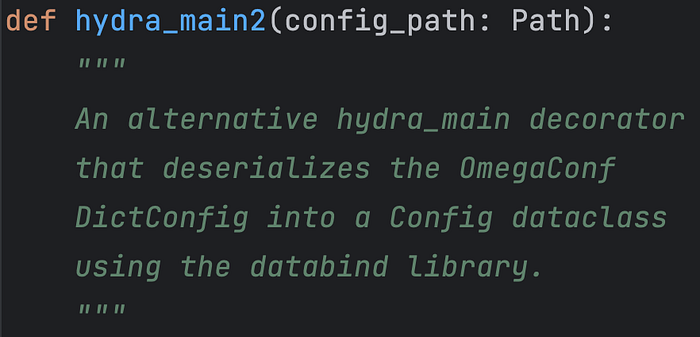
We can then wrap the default Hydra @hydra_main decorator such that it converts an inbound DictConfig into a structured Config dataclass; the latter is then injected into the main function:
"""
An alternative hydra_main decorator that deserializes the OmegaConf object
using intro a dataclass using the databind library.
"""
# Converts the given DictConfig into a Config object with the type
# specified by the main method (ie, typically a project-defined `Config` class).
= .
= .
=
return
=
return
return
return
Using the decorator
The @hydra_main2 decorator is a drop-in replacement for the default Hydra decorator, as this test demonstrates:
def test_decorator_parses_config :
# hydra reads command line arguments as config overrides, so we need
# to remove the pytest arguments in order to not confuse hydra.
sys.argv = sys.argv
@hydra_main2
def main :
assert config.name == "foo"
assert config.answer == 42
assert config.tags ==
assert isinstance
assert config.inputs == LocalDataset
assert config.inputs == RemoteDataset
assert config.inputs == LocalDataset
Note that the Config object supports union types, for example:
@dataclass(frozen=True)
class RemoteDataset:
    url: str
    token: Token

@dataclass(frozen=True)
class LocalDataset:
    path: Path

InputTypes = RemoteDataset | LocalDataset
InputConfigurations = dict[str, InputTypes]

@dataclass(frozen=True)
class Config:
    name: str
    answer: int
    tags: list[str]
    inputs: InputConfigurations
Conclusion
This blog post demonstrates how to combine Hydra with databind deserialization in order to solve a few limitations of OmegaConf: custom deserializers, vanilla collection types, and union types. We are using this mechanism internally at Helsing and are pretty happy with it, so far at least :) If you like this approach, please let us know and we’d be happy to discuss how to contribute it to Hydra proper or provide the alternative Hydra decorator as a library.
Authors
Scott Stevenson and Robert Fink